

Blog
HPE ProLiant Naming Explained: DL vs ML, 360 vs 380 and Gen9 vs Gen10
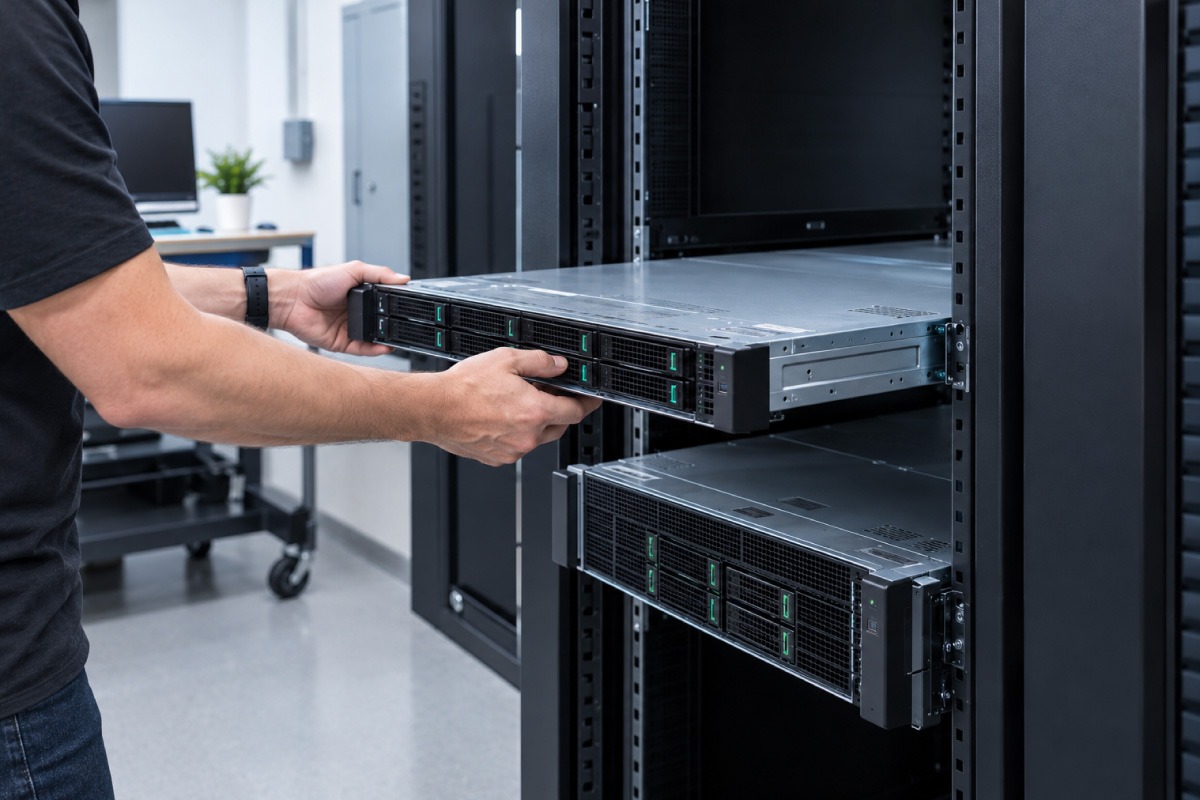
HPE ProLiant model names look like a string of codes: DL380 Gen10 8SFF, ML350 Gen9, DL360p Gen8. Once you know the pattern, though, a listing tells you the form factor, the physical size, the processor platform and the drive layout before you open the spec sheet.
This guide decodes each part of the name and what changes from Gen8 to Gen11.
📋 Key takeaways
- DL vs ML: DL models are rack servers, ML models are towers that can usually be converted to rack mounting.
- 360 vs 380: The DL360 is a 1U server and the DL380 is a 2U server with room for more drives and expansion cards.
- Last digit: A model number ending in 0 is Intel based; ending in 5 (DL325, DL385) is AMD EPYC based.
- Generation: Gen9 means Xeon E5 v3/v4 with iLO 4, Gen10 means Xeon Scalable with iLO 5, Gen11 moves to DDR5 and iLO 6.
- Chassis code: SFF bays take 2.5-inch drives and LFF bays take 3.5-inch drives, and the chassis choice is fixed when the server is built.
What do DL, ML and BL mean in HPE ProLiant?
The two letters at the start of the name tell you the physical type of server. HPE does not lean on the expansions in its own documentation, and even answers on HPE’s community forum disagree on what ML stands for, so it is more useful to learn what each family is than what the letters abbreviate.
- DL: general-purpose rack-mount servers. This is the family most businesses buy, including the DL20, DL160, DL360 and DL380.
- ML: tower servers with extra internal room for drives and expansion cards, most of which can be converted to rack mounting.
- BL: blade servers that only work inside an HPE BladeSystem enclosure. The c3000 enclosure holds 8 blades and the c7000 holds 16.
- Apollo and Synergy: HPC and composable blade platforms, rarely needed by a small business.
The ProLiant overview on Wikipedia lists a few smaller families too, but DL and ML cover almost everything sold refurbished.
What do the numbers in DL20, DL160, DL360 and DL380 mean?
Broadly, the 100, 200, 300 and 400 series are one or two-socket servers, while the 500 and 600 series are four-socket machines aimed at large databases and in-memory workloads.
Series and size
- DL20: an entry-level 1U, single-socket server. The current Gen11 model takes Xeon E-2400 or Xeon 6300 processors and ECC unbuffered memory.
- DL160 and DL180: HPE’s density-focused 100 series. The DL160 Gen10 is a 1U two-socket server and the DL180 Gen10 is its 2U counterpart.
- DL360 and DL380: the mainstream 300 series. The DL360 is 1U and the DL380 is 2U, both with two sockets.
- ML350: the two-socket tower in the 300 series. The Gen10 version is a 4U tower that takes 5U when rack mounted.
The last digit: Intel or AMD
A model number ending in 0 uses Intel Xeon processors, while one ending in 5 uses AMD EPYC. That is why the DL325 and DL385 sit next to the DL360 and DL380 in HPE’s range.
💡 Pro tip: In a 1U versus 2U decision, the extra height buys more than drive bays. HPE’s QuickSpecs show the DL380 Gen10 taking up to 24 front SFF drives (30 with a rear cage) or up to 19 LFF drives, while the DL360 Gen10 tops out at 10 or 11 SFF bays. If you expect to add drives or PCIe cards later, the 2U model gives you headroom.
Gen8 vs Gen9 vs Gen10 vs Gen11: what changes between generations?
The Gen suffix is the most important part of the name for a refurbished buyer. It decides which processors fit, what memory you need, which iLO management version you get and which storage controllers are available. Gen8 rack models often add a letter, as in DL380p Gen8.
| Generation | Intel processors (DL360/DL380) | Memory | iLO | Typical storage controllers |
|---|---|---|---|---|
| Gen8 | Xeon E5-2600 and E5-2600 v2 | DDR3 | iLO 4 | Smart Array P420i |
| Gen9 | Xeon E5-2600 v3 and v4 | DDR4 | iLO 4 | Embedded B140i, H240ar HBA, Smart Array P440ar |
| Gen10 | 1st and 2nd Gen Xeon Scalable | DDR4 | iLO 5 | Smart Array S100i, E208i-a, P408i-a, P816i-a; MR216i/MR416i on later builds |
| Gen10 Plus | 3rd Gen Xeon Scalable, PCIe 4.0 | DDR4 | iLO 5 | MR216i, MR416i, SR416i-a, SR932i-p, plus Smart Array options |
| Gen11 | 4th and 5th Gen Xeon Scalable | DDR5 | iLO 6 | MR and SR controllers such as MR416i-o and SR932i-p |
Gen9 launched with Xeon E5-2600 v3 processors, and HPE added E5-2600 v4 support across the Gen9 range in 2016. Gen10 moved to the Xeon Scalable family, and the HPE DL380 Gen10 QuickSpecs list both first and second generation Scalable parts. Gen10 Plus brought third generation Xeon Scalable processors and PCIe 4.0, as shown in the DL360 Gen10 Plus QuickSpecs. AMD models follow their own path: EPYC arrived with Gen10, and Gen11 AMD models use fourth generation EPYC.
Gen11 is a bigger jump. The DL380 Gen11 product page lists 4th and 5th Gen Xeon Scalable processors, DDR5 memory and iLO 6. HPE announced Gen12 in February 2025 with iLO 7, but Gen12 hardware is too new to appear on the refurbished market in any volume.
📘 Good to know: iLO is HPE’s out-of-band management controller, the equivalent of Dell’s iDRAC. Gen8 and Gen9 use iLO 4, Gen10 and Gen10 Plus use iLO 5, and Gen11 uses iLO 6. Our iDRAC vs iLO comparison explains what each version lets you do remotely.
Shop refurbished HPE ProLiant servers
Browse tested Gen9 and Gen10 ProLiant rack and tower servers, configured to order with memory, drives, RAID and rails.
SFF vs LFF: what does the chassis code tell you?
The drive code at the end of a listing, such as 8SFF or 12LFF, describes the front drive cage. SFF (small form factor) bays take 2.5-inch drives, which suits SSDs and 10K or 15K SAS disks. LFF (large form factor) bays take 3.5-inch drives, which give you the most capacity per bay for bulk storage.
The number is the bay count of the cage and backplane fitted to that chassis. Many models can add bays with expansion kits: the DL360 Gen10 goes from 8 SFF to 10 SFF with a 2SFF kit, and the DL380 Gen10 can grow from 8 SFF to 16 or 24 SFF. The QuickSpecs for each model list which upgrades are supported, and some need an extra controller or cabling.
⚠️ Watch out: Some entry configurations use software RAID that does not support SAS drives. HPE’s DL360 Gen10 documentation notes that models with the embedded S100i controller need a separate Smart Array controller for SAS drives. Check the controller before buying SAS disks, and make sure your drive caddies match the server generation.
Smart Array vs MR and SR controllers: what is the difference?
For most of the ProLiant line, RAID was handled by HPE Smart Array controllers. The names follow a pattern: in Gen10, the S100i is a software RAID option, the E208 models are the “essential” tier, and the P408 and P816 models are the “performance” tier with cache. The suffix shows where the card fits: -a cards sit in a dedicated controller slot on the motherboard and -p cards are standard PCIe plug-in cards.
From late Gen10 onward HPE added controllers based on other vendors’ silicon. MR controllers such as the MR216i and MR416i are Broadcom MegaRAID based, and SR controllers such as the SR416i-a and SR932i-p are Microchip SmartRAID based. Gen11 servers use the MR and SR ranges, with -o models fitting an OCP slot.
The practical difference is management: HPE’s Gen11 QuickSpecs note that MegaRAID tools cannot configure SmartRAID controllers, so procedures written for one family will not carry over to the other. Our guide to Dell vs HP servers covers how HPE’s approach compares with Dell’s PERC controllers.
Common refurbished HPE ProLiant models compared
These are the models you are most likely to see on the refurbished market. Specifications are from HPE QuickSpecs; individual servers vary by configuration.
| Model | Form factor | Sockets | Processors | iLO | Front drive options |
|---|---|---|---|---|---|
| DL380p Gen8 | 2U rack | 2 | Xeon E5-2600 / v2 | iLO 4 | 8, 16 or 25 SFF; 8 or 12 LFF |
| DL360 Gen9 | 1U rack | 2 | Xeon E5-2600 v3 / v4 | iLO 4 | 8 or 10 SFF; 4 LFF |
| DL380 Gen9 | 2U rack | 2 | Xeon E5-2600 v3 / v4 | iLO 4 | SFF and LFF chassis |
| DL360 Gen10 | 1U rack | 2 | Xeon Scalable 1st / 2nd Gen | iLO 5 | 8 SFF (up to 10 or 11); LFF chassis |
| DL380 Gen10 | 2U rack | 2 | Xeon Scalable 1st / 2nd Gen | iLO 5 | 8 to 24 SFF; 8 or 12 LFF |
| DL180 Gen10 | 2U rack | 2 | Xeon Scalable 1st / 2nd Gen | iLO 5 | 8 to 24 SFF; 8 or 12 LFF |
| ML350 Gen10 | Tower (5U racked) | 2 | Xeon Scalable | iLO 5 | Up to 24 SFF or 12 LFF |
| DL360 Gen10 Plus | 1U rack | 2 | Xeon Scalable 3rd Gen | iLO 5 | 8 SFF or 4 LFF |
Which ProLiant generation makes sense to buy refurbished?
For a file server, domain controller or light virtualisation host, a Gen9 DL360 or DL380 is a sensible budget choice. It uses DDR4 memory, has mature firmware and gives you iLO 4 for remote management. Gen10 is the better long-term pick if you want Xeon Scalable processors, more memory channels per processor (six instead of four) and iLO 5.
Whichever generation you choose, check three things before you buy: that your operating system is on HPE’s support list for that model, that the drive bay layout matches the drives you plan to use, and that the memory you want to add is the right type for the generation. Our DDR4 server memory range covers Gen9 and Gen10, and the full HPE server range lets you compare models side by side.
Frequently asked questions
Is HP ProLiant the same as HPE ProLiant?
Yes. It is the same server line. ProLiant became a Hewlett Packard Enterprise product line in 2015, which is why older Gen8 and early Gen9 documentation says HP while later material says HPE. The model naming pattern carried on unchanged, so a DL380 Gen9 labelled HP and one labelled HPE are the same platform.
What does 8SFF mean in a server listing?
8SFF means the server has eight small form factor drive bays, which take 2.5-inch drives. You will also see 4LFF, 8LFF or 12LFF, meaning four, eight or twelve large form factor bays for 3.5-inch drives. The bay count describes the chassis and backplane fitted, not how many drives are actually installed.
Is there an AMD version of the DL380?
Yes, but it has a different number. In ProLiant naming a model ending in 5 uses AMD EPYC processors, so the AMD counterpart of the DL380 is the DL385, and the DL325 is a single-socket AMD rack server. The DL360 and DL380 themselves are Intel Xeon platforms.
Can I reuse Gen9 memory in a Gen10 ProLiant?
Do not assume so. Gen9 and Gen10 both use DDR4 registered or load-reduced memory, but HPE qualifies modules per generation and supported speeds differ between processor families. HPE’s Gen8 documentation, for example, states that previous-generation memory is not qualified. Check the part numbers against the QuickSpecs for your exact model first.
Now that you can read a ProLiant name, choosing a server becomes a lot simpler. If you know the workload but are unsure which model or generation fits, request a custom build and we will configure a tested ProLiant with the memory, drives and RAID controller you need.